Showing posts with label Environment. Show all posts

Monday, June 16, 2008

A Watery Glimpse of the Future?

Some of my dear readers have been wondering how we're doing here in Wisconsin with all of the flooding. Before I begin, let me say that we are fine. We are 1000 times luckier than the majority of people in our area. Our basement is dry, we can not complain. We have had some major damage to our seed crops and lettuce, and our vegetables that survived are overgrown with weeds in fields so soggy we can't possibly step foot in them without damaging the plants. So. We've done what we could. We did two huge lettuce harvests before hail took the remainder that we couldn't get out in time. The refrigerator was overflowing with lettuce. Think I'm exaggerating? That's where you'd be wrong. I have photographic evidence! So that and a car with a few hail dings is really all we can claim as inconvenience. That--and being relatively stranded. We live very near the Rock River. Most of you know we live right up against I-94. Half of it has been closed because of flooding on the Rock. We basically can't get West with any rhyme or reason. We can't get South either without going way east first. We can go North, but not far, and not to any practical purpose. We can easily go East, we just can't get back. The first picture up above shows the Rock River 3 days before we got the last set of really big storms--3 nights before we spent most of the night in our basement listening to tornado sirens go off. We've seen the Rock flood it's banks a bit at this farm before--the normal path is a few yards to the right of the line of trees on the right of the picture. It's crept into this farmyard a bit before, but nothing like this. If you look at the fenceline, you'll see that it's under about 3 feet of water. Now this picture is of the park directly across the water. There is usually a parking lot in front of that sign. (It's still there, just under a couple of feet of water. Notice the picnic pavilion that's barely above water. Now. Like I said, this was three days before the last big wave of storms hit. The day after the storms hit, we were driving home from the North and the bridge was closed. This pavilion? Was 3 feet deep in water. And then? It rained again. A lot. So we can't even get onto this road anymore but I can only imagine what it looks like now. And the farm on the other side--the water has to be up over the ground floor level of that house now. I'd guess their first floor is under at least a foot of water. The water just keeps coming, and there is nowhere for it to go. It is bizarre to be stranded like this. Events are being canceled left and right, local business is suffering since most people are avoiding the interstate, and you just "can't get from here to there" as someone reminisced is once true again. This is all bad--but nothing compared to what's happening in Iowa. The scariest part is that this may very well be just a glimpse of the future as we experience continued climate change, AKA global warming. In other news Sprout graduated from Kindergarten and our little bird turns 5. The world keeps turning on, regardless of climate change, regardless of the rain. It helps a little to know that hopefully our kids will grow up in a brighter future if we all do our part to stop and reverse the changes that past generations have put into motion. As Beo says, and it is more important than ever now: Be the change.

Monday, April 28, 2008

To Go, Green Style

One of my biggest green-smashing vices is take out. Life has gotten a lot busier in the past year with taking on a second job, stepping up the gardening business, and ironically, having Sprout in school. The local coffee shop is the main place we indulge in now and again. They have a divine soup, make a mean veggie sandwich, and have sweets galore. It's all reasonably priced and I like supporting our local, family-owned coffee shop that buys our organically grown produce in the summer. There's just one problem: packaging. We usually eat there, but there's almost always leftovers. I most often eat there with Bird, and she's the only one to get lunch (I eat when I get home), but she always has half a sandwich left over. Yes, the soup comes home in a paper cup, the rest comes home in bulky styrofoam. It finally got to the point where I realized it was time to do something about it, so I went searching, and discovered these items which are some of my favorite new things! The first are Sigg snack boxes, like the blue one pictured at right, and the red one below. These are perfect for putting Bird's leftovers or a sweet treat in. They will also be perfect for when I don't have Sprout's Laptop Lunchbox clean and need to use his regular lunchbox (a soft-sided number). We only use a few plastic baggies a month but I expect these will totally eliminate our need for them. The snack boxes also come in a larger size for people who want to take a big salad to work or otherwise pack a bigger portion. They are lightweight and sturdy, and close securely. The second is a tiffin by To-Go Wear that I first saw on Vegan Lunchbox. It really is divine. I can have soup or a salad in one container, and a half-sandwich or roll in the other. The divider between the two can be used as a little plate. The handle allows you to put in hot foods and not burn yourself walking around. Very handy. So now I can get my take out completely waste free and enjoy my "fast food" with much less guilt. Hooray! I found my new treasures at www.reusablebags.com.

Tuesday, April 22, 2008

Happy Earth Day 2008

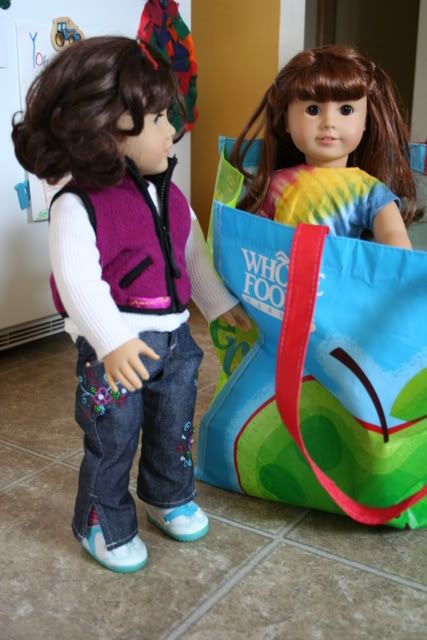
Happy Earth Day! We had a smashing Earth Dinner on Sunday--our 3rd annual Earth Dinner, and it was just wonderful. We had old friends, people from our church, the community--a full house of people talking about food, climate change, and how we can play a part. It was inspirational and heart warming. Wisconsin offered up food that became curried potatoes, chili, corn chips, sourdough and sweet breads, cherry pie, salad, maple popcorn, wine, and more. I got to wear my herbivore "Eat Like You Give a Damn" tee and hang out with eco-friendly friends while eating great food. Yeah, that's pretty much perfection for me. My dolls are helping to spread the message of Earth Day this year, as hundreds of board members access the album that I put together on our Traveling Doll's blog: www.travelingnora.blogspot.com. Check it out for some lighthearted fun. I hope you and yours have a renewing, inspirational Earth Day 2008!

Tuesday, April 08, 2008

April Just One Thing

April's Just One Thing is the two degrees of separation. Did you know that a difference of just a degree or two in your thermostat setting can make a big difference? This is usually a mild time of year, so now might be a good time to try it. If you're thermostat is set to heat, try turning it down two degrees. Already cooling off? Turn it up two degrees. By doing so, you can save about 2,000 pounds of carbon emissions each year! You probably won't even notice the difference in temperature, but you may notice the average energy cost savings of $100! Thank you!

To learn more:
EPA Individual Emissions
Programmable Thermostats

Saturday, March 29, 2008

Spring Craft Time

Bird is getting to the age where she has a bit more interest and patience for "real" crafts. Yesterday, a unique shop on State Street in Madison lured us in again. Anthology, a newer boutique near the Children's Museum end of State Street, combines unique handcrafted art for sale with a few do-it-yourself art projects. The window's bright colors, vintage fabrics, and creativity caught our eye. The shop was filled with bags, cards, magnets, colorful unique quilts, beautiful papers, books, handcrafted toys, jewelry, and other delights. I spotted many items made from salvaged fabrics and papers. I picked up a handmade fabric coffee cozy for when I forget my reusable mugs. A table near the back offered materials and instructions to make your own tissue paper flowers for an insanely reasonable fee. Sprout picked out a "wallet" (change purse) made of an old capri sun juice packet. Bird and I couldn't resist this cute kit from "Artgirlz". We've never been so quick to finish a project! We started on it shortly after getting home yesterday, and finished it up this morning. Bird was more than willing to attempt some sewing as we appliqued a big "E" on the front (yes it's true, "Bird" is not her given name); and happily strung beads despite a frustration here and there. I think the thought of the finished project made it worth it for her. I can't believe we didn't have a single meltdown, as she's been more prone to tantrums lately. There's a little flower garden started on the other side of the bag, but Bird was so overcome with the present success of the bag that she wanted to call it quits for now. I'm totally fine with that. It's nice to have a project that looks so great and was so easy to do. This allowed Bird to be creative and still have an incredible finished piece, so we'll be looking for similar projects. Overall, I think this was a big success, and I hope we'll be doing more crafting like it in the future. Anthology will be a good source. I highly recommend that you check it out if you're in the area!

Monday, January 28, 2008

More Ways to be Green

The Nature Conservancy is one of my favorite organizations. They have a realistic, dig-in-your-heels, practical approach to-you guesssed it-conserving nature. Back when I visited my sister in Door County, she was doing scientific work with endangered dragonflies, in part on Nature Conservancy land. Now The Nature Conservancy has a new way to protect nature--encouraging "Everyday Environmentalism". Check out this new page, which gives some tried and true ways to be green, and other ways that you may not have thought of or heard of before. Have you thought about taking the stairs instead of elevators as an environmental choice? Do you clean your boots after you hike to prevent the spread of invasices? These ideas come from TNC's own staff as well as some of the top eco-bloggers out there. What's even better is that they want your ideas too. So check out the page and get some new ideas for ways to go even greener than you already are, then echo your own back to TNC.

Wednesday, April 18, 2007

Bird's Nests

The birds all but disappeared this winter. Despite our food stock for them, our goldfinches, sparrows, and house finches were seldom visitors. This week, as Spring arrives (again), we've finally been graced with sweet songs from some of our favorites. Today there was a cheeky little house finch, singing his heart out from a sapling in our front yard. I watched as he flew down to our garden and tore a few pieces of newspaper from a piece of mulch in our garden. He inspired me to provide some more material for our guests.

The kids and I gathered up some used scrap paper, and yarn ends, and set to snipping them into beak-friendly pieces. Four inches is the reccomended length for thread, yarn, etc. While searching for that handy fact, I saw this great article on building a nesting materials site for birds, in Wonder Time. I actually subscribe to this magazine but rarely find time to read it. They suggest using a mesh onion bag to hold the materials. We packed our yarn and paper into an onion bag, pet the dogs for a little more material to add, then the kids snipped small holes around the bag for the birds to be able to poke around in. We tied it together with a piece of yarn at the top, then hung it in a small tree near our feeder.

This was a nice little Earth Day project for the kids--free and simple, and I plan to have it be an ongoing project as we come up with things like dryer lint that we can add to our nesting collection. The kids were thrilled, and are anxiously waiting at the window to see if we get any takers. I'll keep you updated on whether we have success on the bird's end!

Saturday, February 03, 2007

Frugal is the New Green

There has been a lot of talk lately on how being Green can be so frugal. Daily Kos, Ethicuran, and Groovy Green along with others have been touting all of the penny pinching that comes along with greening up a lifestlye. Beo has discussed on his blog how we have found that we can afford organic by making more things from scratch and cutting down on packaging. Over the past few months we've been trying to make more out of less, both for the environment and for our budget. I've been surprised at what a difference some of the little things really make.

One item we've swtiched to is bulk beans. I've had people telling me for a while that my canned beans were a convenience food, and I've scoffed and kept on stocking my pantry. Do you seriously think I have time to cook my own beans? We eat beans like they're going out of style. Sure, some organic beans are $1.79 and up per can, but at 99 cents a can, Whole Foods was making it easy for me to think canned beans are frugal in and of themselves. I decided to try a batch or two of bulk beans, and they were so easy that I gradually started switching over to all of our beans in bulk. Today I took the last step and bought bulk dried garbanzos instead of canned. I decided to do some weighing and measuring and seeing how much I was saving not just in packaging but also in cost. It turns out I'm paying an average of 25 cents for the same amount of beans that I used to pay 99 cents for in a can. No can, no sealing, no label, and I'm saving a whopping 75 percent. Not bad at all. In this veggie household that's saving us a bundle on soups, chilis, casseroles, and hummus.

Another switch we've made is a bit less about Green and more about frugality. When I read Kos's article about Kossacks being Frugal, I skimmed the list of reader submitted ideas on saving money. One was "Give up Coffee". Behind it, Kos had written "(You first.)" I laughed hysterically. But guess what? Yesterday I finished packing up our $100 coffee pot and stowing it away. We are coffee lovers extrodinaire, but we decided it was time to give up our daily 6-cup each habit. Neither of us is sure how we came to this conclusion. I had a splitting headache one day when sharing our coffee with visitors meant I didn't get as much as usual. The next day I was late in getting my coffee and the headache worsened. It was so severe that I decided that I didn't want to have something messing that much with my body chemistry, and I've only had a cup or two now and then since then. I started drinking a lot more tea, and soon Beo was on board as well. I ran the math, and I figure that we were paying almost 50 cents a cup for the shade-grown, fair trade, organic coffee that we brewed at home. The cost of a cup of tea? 15 cents. It varies a bit with the varieties we choose, but that's the average-and this is high end tea. What's more, that cost doesn't take into account re-using your tea leaves, which we do, so you can cut that in half again. We're still working on balancing out the smaller choice of organic varieties in the Tea world, but we've ordered a variety and are buying from Republic of Tea, which is a fair trade certified company. (Some of their teas have an additional Fair Trade premium on top of the already fair trade price.) We're not giving up the bean entirely, we've ordered a french press for an occasional brew now and then, but in the long run the switch from coffee to tea is saving us anywhere from $500-$1000 this year (depending on how much we'd have brewed day to day.)

I'm also happy to report that I finished the first month of 2007 within my budget limitations for kids clothes spending, and hit my goal for buying 50% of it second hand. Green = Frugal. The great thing is that like my diet-diet last year, the success of my financial-diet this year is motivating me to keep on track and see how much farther we can go. Stay tuned for frugal meal ideas. I've declared next week "Soup Week" on EcoMama Musings, and will share some of our favorite recipes.

Saturday, December 02, 2006

A Tale of Two Cabbages

I've been meaning for some time now to write about the vilification of Whole Foods, and how thoroughly I reject that vilification. The Omnivore's Dilemma is a very valuable book that explores food issues well in some areas, however I took great issue with Michael Pollan's characterization of Whole Foods and it's role in the Industrial Organic world. (As an aside, I don't necessarily have a problem with Industrial Organic, but that's not the point right now.) Pollan cited the lack of local organic produce, and chose extremes like out-of-season organic asparagus from South America to illustrate his point. As it turns out, Pollan didn't even bother to contact Whole Foods about his book. Pollan claims that he was trying to take a purely consumer perspective, and didn't want to get too journalistic about it. If this is so, then it was terribly shortsighted. (See Whole Foods CEO John Mackey's letter to Pollan, and follow their exchange, here.)

Pollan had obviously never been to my Whole Foods. If he had, he might have been impressed. Generally there are at least a few dozen varieties of local organic produce being offered. The number of local selections is advertised daily, and it's often more--I've seen it as high as the 70s. When we worked on a small organic farm southwest of Milwaukee, we learned that the CSA sold excess produce to the Whole Foods. We were very impressed, since they are a relatively small operation. Our Whole Foods carries a number of items from Tipi Produce, a farm just about 20 miles away, and I've seen one of the farm owners at the WFM dock, unloading their truck himself. Apparently not all Whole Foods are this good about stocking local produce, and I suppose it depends on the availability in their area. My personal feeling is that every local item they stock is a huge boon to that local organic farm, and rather than blighting Whole Foods for not having more, we should praise them for what they do have. To me, even the Iowa zucchini or Washington pear is better than the conventional alternative at Pick n' Save--and do we think Pick 'n' Save is going to have local choices? I can assure you, they do not.

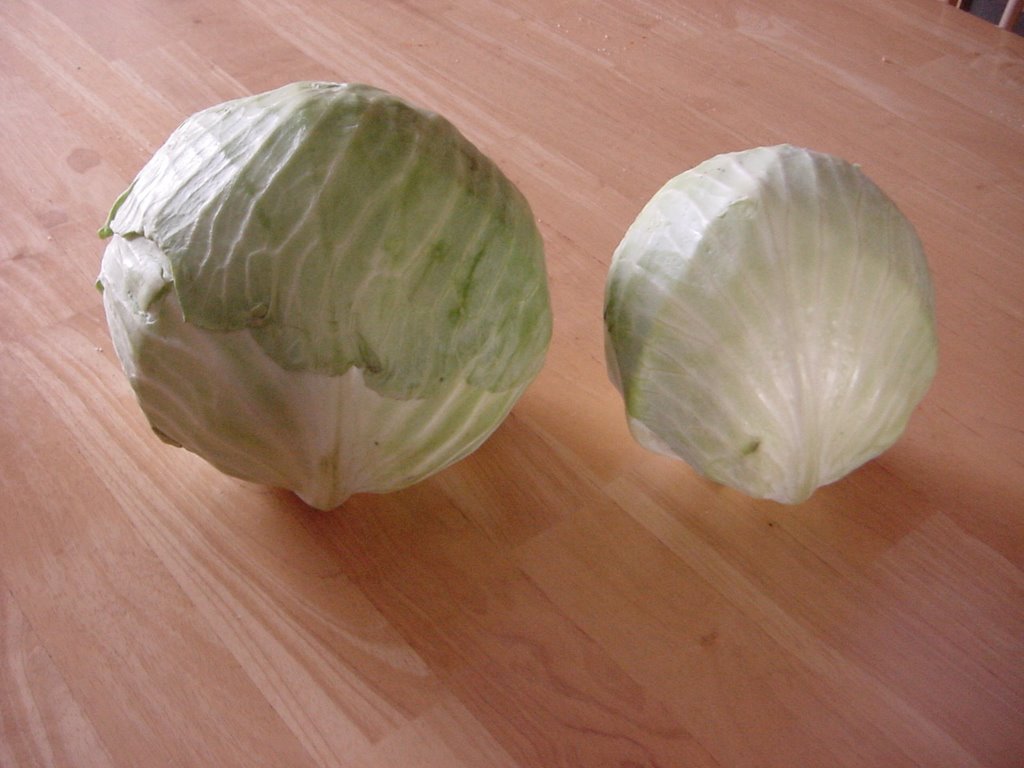
Today was a shining example in favor of Whole Foods. Our Farmer's Market goes indoors for the winter. While there's still an impressive selection of veggies available, most of the booths are now crafts or meats. Even my favorite feta artisan was missing today--a sad day indeed. Our favorite booth still had a great variety of root crops, but no cabbage. I have a cabbage dish planned, and so searched thrrough all of the booths, and finally came back to the only one I had found. The box of cabbages was labeled: "$1 each". I asked the farmer if they used sprays. "Sprays? Yeah I use sprays. 'Course these have been in storage for a long time, and I haven't sprayed since September." I'm not sure what that was supposed to mean. Had he harvested before he sprayed? I don't think so. Did he think the pesticides had worn off with time? I grimaced, then handed him a dollar and selected a cabbage (see the cabbage on the right above). I still hadn't decided if I'd actually use it. Next we went to Whole Foods for our remaining groceries. I selected a locally grown organic pumpkin, passed up some local organic white mushrooms for crimini, and picked up a pound of organic Wisconsin cranberries. As I searched for (and found) local organic leeks, I spotted some gorgeous cabbages. I searched for their sign above, and lo and behold, they were local and organic (see cabbage on the left). Understand, I found a better choice at Whole Foods Market than I did at our incredible Farmer's Market. Besides the produce, I found locally (in-town) produced veggie burgers and baba ghanouj, milk (Organic Valley, but still-produced within an hour or two drive) and local yogurt, whose maker was handing out samples right there at WFM. Upon returning home, I saw that our favorite farm stand at the Farmer's Market sells to WFM too. (In fact, click the link to see the guy who sold Beo his 25# of sunchokes this Spring!) I think I had a better local haul at Whole Foods then at our farmer's market, which I consider one of the best in the world. Perhaps my Whole Foods is one of the best in the world too, and I've simply lucked out. Either way, it's part of the Whole Foods company, and it deserves to be recognized for the wonderful role it is playing in making small organic farms sustainable in Wisconsin.

Wednesday, November 15, 2006

Catalogical

My degree is in Anthropology, and my related studies delved into archaeology as well. My favorite study in that field was that of pseudoscience and pseudoarchaeology. The "scientists" who say that certain Inca carvings show that they had space travel and communicated with aliens; that the Mayan pyramids prove that the Egyptians sailed the ocean long before common science says humans did, and taught them how to build pyramids. While some of it sounds silly, there's plenty of pseudoscience that's quite damaging, that people believe wholeheartedly, such as the "science" behind many Creationist arguments. I digress. When one of my favorite professors was introducing us to the subject, we read two 'articles'. One described an archaeological site found 2000 years from the present. It was thought to reveal a ritual site at which some highly socially ranked individual was making a sacrifice. Of course it was obvious to us that it was a frat boy hugging a toilet. The second article purported to use mathmetical equations to show that if everyone kept saving their issues of National Geographic, the earth would eventually not be able to stand the added volume, and there would be grave consequences. I wish I could find the joke-article, so I could remember what all was going to happen. A change in the gravitational pull of the earth? Tidal waves, earthquakes, eventual collapse? I want to know, because I'm afraid it might happen--not with National Geographic magazines, but catalogs.

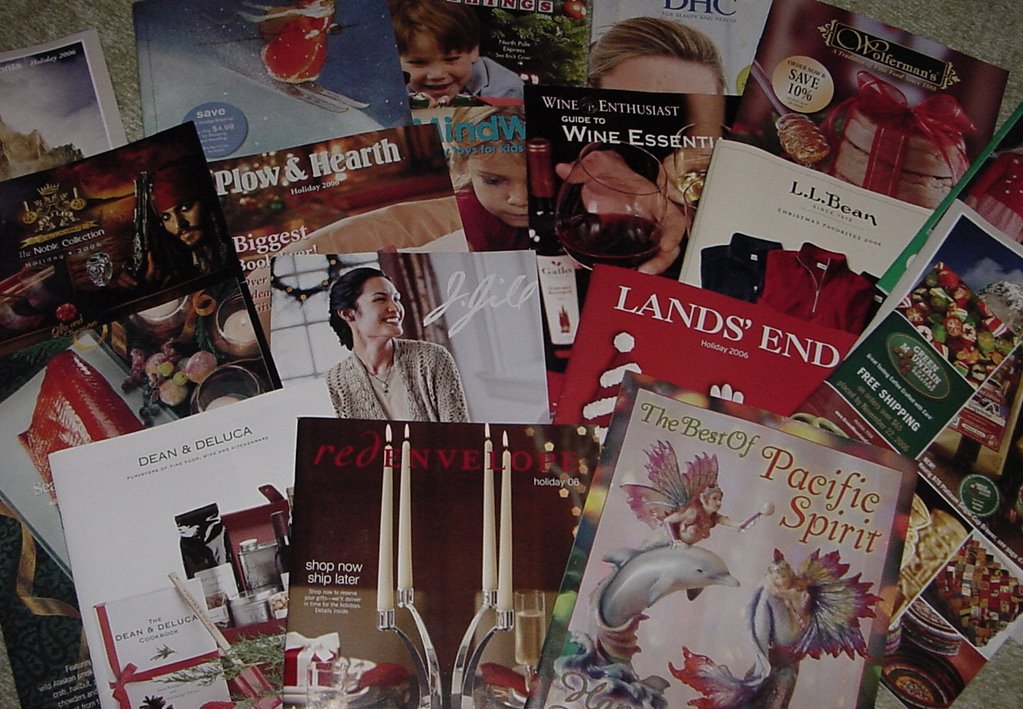
I don't know where they all come from. Some I have actually ordered from, and they're fine. Others I've ordered from and I get two or three catalogs from because they have my name misspelled or un-hyphenated, etc. Others seem to think that they need to send me a catalog every week in case I've lost mine. Some are connected behind the scenes. I order from a toy catalog and come to find out that the clothing catalog and home furnishing catalog I receive are owned by the same company. I would have to guess at where all of the liberal catalogs got my name--there are plenty of suspects. I'd like to know who sold my name to Pottery Barn, Pier One, L.L. Bean, Land's End, and a myriad of home furnishing catalogs, which started showing up in our mailbox shortly after moving into a new subdivision. The mortgage company? The home builders? Who was it? Regardless, I'm receiving about a dozen catalogs every day now. I go through the rigamole role of sorting through them, making piles of "Might Order From", "Approved and Just Like to Look at", "Already Unsubscribed", "Must Unsubscribe". I can only handle 2-3 removal requests at a time. I have to jump through hoops, and the response is always that catalogs are pre-printed, and I'll receive 2-3 more catalogs before they stop. Just enough to get me through the holiday season I suspect. So far I've resisted giving in too much to the advertising aspect of it. Even with "Free Shipping!" and "$10 off your $65 order!" I've remained fiscally solvent, which is quite an accomplishment for me.

Besides the advertising being shoved into my mailbox, the environmental aspect bothers me immensely. There are only one or two of the two day haul pictured above that are printed on recycled paper. What a waste, to picture the resources that went into that catalog, and that's duplicated across the country. It's shameful. Of course I recycle all of my unwanted catalogs, but I'm nosy and can't help but wonder what my neighbors do with theirs. Do they buy that pig shaped casserole dish, which they never knew they needed so much? Do they suscribe to the wine of the month club? Do they order the Super-Low-Price toys without a second thought to why they're Super-Low-Price? Perhaps scariest of all, do they recycle them? Or do they pile up in the back room, collecting dust, moving towards the day when the piles of sheeted ink will cause Earth's gravitational fields to shift?

Saturday, October 28, 2006

Tricks in Treats

Tempted by all of that chocolate this year? Don't forget that a lot of those "fun size" goodies laying around are made with cocoa harvested using child labor, in terrible conditions. Companies like Nestle, Hershey and Mars have agreed to work to eliminate child labor and slavery from their sourcing, but they continue to source from the Ivory Coast, where these problems are rampant, and continue to refuse to offer fair trade prices to their cocoa growers. You don't really want to eat something harvested by impoverished (and by some claims, enslaved) children, do you?

If you're giving out treats, check out Endangered Species chocolate squares, packaged up in a jaunty orange wrapper for Halloween. This is the second year in a row that we'll be giving them out. They're on sale at WFM this week for $2.99 a bag! (That's an incredible deal.) If you get kids who make a face and say: "What's this?" (Not that that's ever happened here!) you can either launch into an expose on fair trade and all-natural chocolate, or simply say, "Beggars can't be choosers."

Resources
In-Depth Info from LaborRights.org
Care 2 Petition to Nestle/Mars
Fair Trade Chocolate Sources
Wire Tap Magazine Article 2005

Sunday, October 15, 2006

Guilt-Less Shopping Guide

The more I've researched, the more I've found how complicated the issue of responsible consumerism really is. I have some tips for how to do research on what you're buying, but I also want to make clear that I realize that it's not feasible to be perfect. In fact, we have very few "perfect" options. Even Fair Indigo, whom I cited in my last post on this issue, takes flak for not revealing the source of their Fair Trade products. Mostly I think that's just a PR issue for competing retailers, and Fair Indigo has defended themselves well. If you're just looking for a good store or company to do everyday shopping with, IdealsWork.com is a good starting point. If you are trying to find one brand of something that you're going to buy a lot of, then that's the place to really dig deep. For example, after hours of research, we buy 99% of the kids clothes from Hanna Andersson. When I was re-stocking my wardrobe, I bought new from amazing Patagonia and also Prana, and tried to buy things that weren't so fabulous company wise second-hand. We buy a lot of high end shoes, so I really did my research on those. If you tend to stick to one brand of beauty products, do your research. You get my drift. Now, some pointers for doing that research.

1. Google! Search the product name followed by "human rights", "labor practices" "factory" "working conditions". A lack of information is a good thing. If nothing comes up, make sure there isn't a higher up parent company. Merrell shoes, for example, is owned by Wolverine Worldwide. While nothing comes up for Merrell, Wolverine has a history of violations. I discovered that they have taken major steps to turn things around, which brings us to the next point.

2. Make sure you have the most recent information. I was dissapointed to see that a number of flags came up for violations from 2-6 years ago. A lot of this outdated information was on Amnesty International's watch site. I personally felt that a lot of their information was really digging too far, and "eating our own", but they do have very thorough information. Further digging showed that things have really turned around. If you do find information on past violations, you'll have to dig deeper to see what they've done to correct things. Look for things like changes in CEO, using overseas watch dogs to monitor conditions, etc. Levi's used to be a major violator, but they have won awards for their turn around, and are actually going to be introducing an organic cotton line.

3. Stay away from China. Unfortunately, there's something to be said for buying Made in the USA, although that's not a guarantee of fair labor practices. (Just look at Walmart!) European companies are generally good on labor as well. Just make sure that their product is manufactured in Europe and their sourced items are clear too. Ecco is a shining example. They own everything that goes into their shoes, right down to the farms where the leather is sourced. Look on their website and you will even find the addresses of all of their factories. Transparency is a good thing.

4. You get what you pay for. Even if something is expensive, do your research, but it tends to hold true. The fact of the matter is, the reason you can pay $1 for a bottle of shampoo is that someone got paid pennies to make it. Aveda is another award winner for their natural sourcing and labor practices. They have extensive reports that even analyze their shortcomings. Will your shampoo cost you $32? Yes, but it was sourced sustainably and someone got paid fair wages to make it. The same is true all the way down the line. Learn to love more with less. Pay for equity and justice. Vote with your dollars.

So what if you go through all of these steps and either can't find the information or are concerned about violations? Contact the company. I have sent out a plethora of e-mails over the past weeks. Most I got a form response, and they basically said that they do their best. I trusted the ones that told me how they make sure that their standards are met. I vetoes the ones that I got no response from. This isn't a foolproof way to do your research, but it's still important because the company hears that you care and are concerned about the issue. Especially if you are a devoted customer of a brand, make sure they know how important labor issues are to you--even if their record looks clean. The fact is, it is hard for big companies to find fair labor, and only demand will increase supply at this point. Of course, buying second-hand is almost always responsible in every way imaginable, but not always an option.

We can't all be perfect, but we can all make an effort to do our best to make sure that the world is what we want it to be. The first step is opening our eyes to the reality, the second is acting to change, and the third is speaking out. So please, take the time to do the research and make sure that your votes with your dollars are educated.

Ethical Consumerism

Prepare for me to wax dramatic. I'm feeling very passionate about this issue. I've long been a supporter of fair trade coffee, chocolate, and sugar. I check the labor practices of the companies I buy the kids clothes from. Somehow I've remained blind to the big picture.

We recently watched "Wal-Mart: The High Cost of Low Price". If you haven't seen this movie, I highly reccomend that you do. I don't think it's a perfect movie, and in fact I think some of it was a stretch. The film makers also have a website, but there is some inaccuracy there for sure, as they list Jefferson, WI as a "victory" having stopped Wal-marth and unfortunately, the nearby town is actually throttling full-steam into Walmartdom. However, there is some good information in the movie. There was much in this movie that was disheartening and depressing, but it was one relatively small portion of the movie that hit me the hardest, and that was the manufacturing labor.

The film makers visited a company in China that manufactures products for Wal-mart, and showed the squalid conditions that the workers are forced to live in. (They are charged rent whether they "choose" to live there or not.) The food is so bad that workers rent kitchens to prepare their own food. The workers work long hours in terrible conditions, and make cents an hour. You really need to watch the movie to see the conditions. I will admit that I sobbed through the last portion about the labor practices. The film makers interviewed a former Wal-Mart employee whose job was to evaluate the labor practices. He didn't realize that his real job was to lie about the factories, and he got fired for telling the truth. This wonderful man said that the first day that he visited a Wal-Mart factory, he went back to his hotel room and wept. I would too. We are paying $15.99 for a toy that cost Wal-Mart .37 cents to make. This is slavery people. Slavery. Slaves got room and board too, right? That's about all these people are getting. Thousands and thousands of people, working for pennies, sweating, slaving.

What bothered be the most was the almost instantaneous realization that it's not just Wal-Mart. If I walk into Target and buy that toy, I'm no better off. What about clothes? What about towels? What about everything that my dollars go to? You'd think that a little research would go a long way, but I'll tell you that I haven't found it all that easy. While I've found great websites for Europe and Canada that help consumers figure out who and where to buy, I couldn't find much that was simple for American consumers. I googled and googled, and I did find links to buyblue.org, and various fair trade organizations. I wanted to find something that helped me find the best everyday companies though. Long ago I found a site that did this, so I hacked back into an old chat board and found my posting. The site is www.idealswork.com. As far as I can tell, they do a great job of creating a ratings system that is based on the values you choose, be it environment, labor, gay rights, etc. It is not comprehensive and often gives ratings for stores rather than brands, but it's a good start.

One thing I discovered is not to trust the website of the company. Of course they paint a very rosy picture. I checked out Mattels corporate responsibility practices and standards, and they all look great. Unfortunately they don't hold to their own standards. I found various reports of them paying factory workers 40% less than the legal minimum wage for where the factory was located. So really do your research. I researched for hours, literally, until I was convinced that Hanna Andersson was the company we would buy the kids clothes from, guilt free.

We have a responsibility as members of the human race to educate ourselves about where our products are coming from. Before you spend another dollar, make sure you're not paying for a rich executive to get fatter while someone sweats and starves. It's dramatic yes, but sadly it's also the harsh reality of America. We're living our lives on the backs of poor workers. It needs to stop.

Other Resources:
Recent Chicago Tribune Article
Fair Indigo
Global Exchange
Fair Trade Federation
Sweat Free Shopping

Monday, July 31, 2006

I Believe in Organic Valley

Sunday I had the great pleasure of taking my family to the Organic Valley Kickapoo Country Fair. This is our second year attending the fair, and it was again a wonderful experience. I am a big-time Organic Valley advocate, because they are the future of Organic. They enable small family farms to be distributed on a national scale. Their system is so real that you can see the inner workings every year at the fair. In fact, I wouldn't doubt that if you called OV up, they'd arrange a tour for you at your convenience. The headquarters actually look a lot like the corporate logo, a large modern office structure but it looks like a barn. They have 20' swaths of native prairie planted on both sides of the long drive up to headquarters. Their aluminum roof channels rainfall into a system of giant holding tanks, which are tapped to water the vegetable gardens. They are as real as real can be. They are also located in one of the most beautiful parts of the country-the "driftless region" of the kickapoo valley, with rolling green hills, forests, streams, and rock outcroppings.

Each year the fair brings together many of the OV farmers, as well as other local organic farmers, artisans, coffee roasters, food co-ops, musicians, eco-organizations, and more. We passed booths with t-shirts with 'liberal' slogans on them, a fundraising booth for Habitat for Humanity that was selling organic ice cream, a hand woven rug stand, a booth for Chelsea Green publishing, a corn pellet stove manufacturer, an alternative energy cooperative, and the like. Good food and drink were in abundance. OV had a large crew of people separating recyclables from trash from compostables. (Even the paper plates, 'plastic' cups and spoons, and water bottles were compostable, thanks to OV.) The kids and I enjoyed making crafts and checking out the animals. (OK, the kids were a little wilted from the heat, a bit pouty, but it was still really neat. Meanwhile Beo took a course on Resources for Organic Gardeners and Farmers. He had to pass up a course on 70 mpg, 0 Emissions vehicles and Sustainable Building to attend that one.

After a lunch of a veggie burrito, pesto pasta salad, organic milk, and fruit, we headed on to a bus to tour one or OV's dairy farms. It is nestled in the hills about 20 miles from OV HQ, run by a really swell guy and his wife. The farmer told us a bit about how he and his wife got into organic dairy farming. They were drawn in by the appeal of seasonal milking. This means that they follow the cow's natural milk cycle, instead of forcing them to milk year round. The cows are allowed to "dry up" in November, and milking resumes in March. I love that system--it seems so much more--well, natural! The farmer took us out to the high pasture, and talked about the challenges of managing the balance between the natural grasses and clovers that grow there, along with what the cows like and need. He does semi-intensive rotational grazing (12 hours in one spot of field) but makes sure the cows are happy no matter what. He gets more milk out of them that way--but I'll take happy cows no matter what the motivation. So yesterday, with the heat, the cows not only had about 3 times the pasture space that they normally did, but he had opened up the lower "emergency" pasture to them. The lower pasture is in a valley and has lots of shade, so the cows can go down there to cool off if they feel like it.

This particular farmer has about 39 cows. We heard the OV represenative talking about how they breed for cows that like being out on pasture. He explained that if they stuck holsteins out on natural pasture, they'd hardly know what to do with themselves. So we heard about highly mixed cows--milking shorthorn, jersey, and more. The farm that we were at uses a bull as well as AI. The family built their own home on their land, as well as building the milking parlor. I was really impressed with how clean the milking parlor was. I realize they were prepped for a tour, but it was a working farm and I think it probably is kept that clean. The only ethical problem left that I can see is what happens when a bull calf is born. He had two there at the farm yesterday. I think I heard him say they were the only two born that year. Conversations overlapped and answers got hard to hear, but I thought he was saying that they keep them for a year and then they go into the OV meat production area. I have to say that I feel like that particular impact is a small one, ethically. Environmentally there is very little impact (one of the calves we saw was in a smaller penned area with pasture), and it fills a market demand in a very positive way. ( Even if I'm not going to eat it, I would much rather the cow be grazing pasture in the Kickapoo Valley than being raised in a stall fed on corn at an Aurora facility.)

It's hard for me to explain how powerful the experience really is. I feel incredibly un-eloquent and choppy--I could write for pages on why I feel so strongly about OV. It's too easy to get caught up in the details, and I want to be able to share everything about how amazing the farms are, and how much the farmer cared about his cows. He had names for each of the cows and would laugh as he shared about their personality. The cows were so docile, even friendly and sweet. They seemed to have the perfect life, having all of their natural needs met and with quite a view to boot. I know a lot of people have doubts about the humanity of milk, and the veracity of organic. I can honestly say that I feel even better about Organic Valley after having seen the workings of the farm than I did even before I went out there. If you are a milk drinker, and you believe in Organic, Organic Valley is the company to support. If you'd like to see more about the fair, you can visit OV's webpage.